Vernacular Snapshot
Amateur, candid photographs from the Kodak era onward — vernacular history, in shoeboxes.

Vtg B&W Snapshot Horse Drawn Carriage Ride City Plaza Fountain 1950s Deckle Edge

Vtg B&W Snapshot Little Girl Riding Pony Horse Deckled Edge Photo 1940s

Vtg B&W Snapshot Two Girls Overcoats Berets Stuffed Easter Bunny Yard 1940s

Vtg B&W Snapshot Mother Daughter Black Dog Porch Steps Matching Hats Suits

Vtg B&W Snapshot Hand Tinted Portrait Woman Glasses Floral Blouse 1935

Vtg B&W Snapshot Woman Sitting Near Christmas Tree Presents Doll Crib 1950s

Vtg B&W Snapshot Boy Keystone Area Council Pennsylvania Bsa Gateway Camp Tent

Vtg B&W Snapshot Cute Children in Winter Overcoats Brick Wall Street 1950s

Vtg B&W Snapshot Pretty Fashionable Woman Spectacles Porch Steps Heels Dress

Vtg B&W Snapshot Striped Hyena Wild Animal Caged Zoo Heavy Wire Enclosure 1940s

Vtg B&W Snapshot Toddler Child Riding Pony Horse Outdoor Deckled Edge

Vtg B&W Snapshot Campground Tent Camp Canopies Picnic Tables Outdoor Meadow

Vtg B&W Snapshot Three Police Officers Military Men Uniforms Caps Porch 1940s

Vtg B&W Snapshot Cute Toddler Baby Child Tea Party Dog Pet Deckle Edge 1940s

Vtg B&W Snapshot Smiling Woman Sitting Touring Car Open Bus Men Boater Hat 1920s

Vtg B&W Snapshot Woman Sitting Front Porch Steps Flower Basket Manton MI 1936

Vtg B&W Snapshot Mother Leila Burney Older Women Screened Porch Portrait 1956
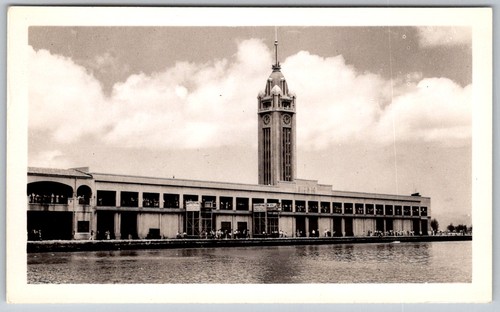
Vtg B&W Snapshot Aloha Tower Honolulu Hawaii Harbor Waterfront Clock Tower

Vtg B&W Snapshot Child Toddler Girl Swinging Swings Playground Woods Outdoors

Vtg B&W Snapshot View Through Vehicle Windshield Dirt Road Rural Countryside

Vtg B&W Snapshot Family Portrait Seated Woman Men Suits Cloche Hat Garden 1920s

Vtg B&W Snapshot Smiling Woman Long Winter Overcoat Tie Bare Trees Yard

Vtg B&W Snapshot Children Fancy Dress Costume Party Dancing Deckled Edge 1940s

Vtg B&W Snapshot Man Plaid Shorts Pipe Water Wheel St Augustine FL 1963
Snapshots are amateur photographs — candid, casual, made by ordinary people with consumer cameras. The snapshot era opens with George Eastman's 1888 Kodak No. 1 (the first true consumer roll-film camera) and goes mass-market with the $1 Brownie in 1900. Sizes follow the film format and printing technology of the day, so dating a snapshot often comes down to its dimensions and paper.
HistoryOrigin & era
The first widespread amateur prints came from the 1888 Kodak No. 1 and exploded after the 1900 Brownie; the postcard-back era (1907–1930s) gave us the Real Photo Postcard (RPPC). Mid-century brought silver-gelatin prints with deckled (scalloped) edges; from the late 1950s the standard shifted to chromogenic color, finally settling on the 4 × 6 in print that still dominates today.
IdentificationHow to spot a Snapshot
- Silver-gelatin paper (most pre-1970 black-and-white) has a slight surface sheen.
- Deckled / scalloped edges are typical of c. 1940s–1960s prints.
- "AZO" or "VELOX" stamps on the back date the paper to specific decades.
- Postcard-back prints (POST CARD divided back) are 1907 onwards.
- Color prints with white borders are largely 1950s–1970s.
Snapshot sizes
Snapshot sizes track consumer film formats. Each entry below lists the print size and the era it dominates.
| Format | Inches | Millimeters | Notes |
|---|---|---|---|
| No. 1 / 2 Brownie contact print | 2¼ × 3¼ in | 57 × 83 mm | Early Kodak roll-film, c. 1900–1930s. |
| Real Photo Postcard (RPPC) | 3½ × 5½ in | 89 × 140 mm | Postcard-back era, 1907–1930s. |
| Postcard variant | 2½ × 4¼ in | 64 × 108 mm | Less common postcard-era trim. |
| 116 / 616 contact print | 2½ × 4¼ in | 64 × 108 mm | Folding-Kodak roll film, 1900s–1950s. |
| 620 contact print | 2¼ × 3¼ in | 57 × 83 mm | Box and folding cameras, 1930s–1950s. |
| Square (127 / 620 square) | 3½ × 3½ in | 89 × 89 mm | Mid-century box cameras, 1940s–1960s. |
| Standard small print | 3½ × 5 in | 89 × 127 mm | Silver-gelatin, c. 1940s–1970s. |
| Modern enlargement | 4 × 6 in | 102 × 152 mm | Color processing, 1970s onward (still standard). |
| Studio enlargement | 5 × 7 in | 127 × 178 mm | Common formal-portrait enlargement. |
| Large enlargement | 8 × 10 in | 203 × 254 mm | Studio portraits and event photos. |
Common questions
What counts as a vernacular snapshot?
A vernacular snapshot is an amateur photograph made by an ordinary person rather than a studio — candid, informal, often unposed. The format begins with Eastman's 1888 Kodak No. 1 (the first true amateur roll-film camera) and went mass-market with the $1 Brownie in 1900. The term covers everything from Real Photo Postcards to mid-century color prints.
What is a Real Photo Postcard (RPPC)?
A Real Photo Postcard is an actual silver-gelatin photograph printed on postcard-back paper, sized about 3½ × 5½ inches. Popular from 1907 into the 1930s, RPPCs are real photographic prints (not lithographs) and can often be dated within a few years by the stamp box on the back (AZO, VELOX, KRUXO, etc.).
How do I date a snapshot?
Border, edge, and paper give the strongest clues. Postcard-backs are 1907–1930s. Deckled (scalloped) white-bordered prints are roughly 1940s–1960s. Square prints (3½ × 3½ in) come from mid-century box cameras. Color prints with white borders are 1950s–1970s; borderless 4 × 6 in color prints are late 1970s onward.
Are old snapshots worth anything?
Most family snapshots have only sentimental value, but vernacular photography has a strong collector market. Snapshots with striking compositions, unusual subjects, early color (1940s–1950s Kodachrome), occupational scenes, or historical content (war, civil rights, Americana) can range from $5 to several hundred dollars individually, and large curated lots routinely fetch multiples of that.
Have Snapshots to sell?
We buy vernacular snapshot singly or by the lot. Send a few photos and we'll have an offer back in 24–48 hours.
Get an offer →