
Vernacular Snapshot
Amateur, candid photographs from the Kodak era onward — vernacular history, in shoeboxes.
Vtg Color Snapshot Three Men Sitting On Striped Couch Casual Wear Hats 1990s

Vtg Color Snapshot Women Playing Softball Game Sports Field Man Coach 1990s

Vtg Color Snapshot Woman In Esprit Sweatshirt & Teenage Boy By Fireplace 1990s

Vtg Color Snapshot Couple Smiling Man Thumbs Up Woman Big Hair Pepsi Soda 1990s

Vtg Color Snapshot Group Of Men Posing Outdoors In Casual Sporty Clothes 1990s

Vtg Color Snapshot Two Young Men Martial Arts Stick Performance Gym Crowd 1990s

Vtg Color Snapshot Two Women Looking Back Outdoors Sports Field Fence 1990s

Vtg Color Snapshot Group Men Women Red Shirts Sports Team Field Outdoors 1990s

Vtg Color Snapshot Man Sleeping On Couch With Race Bib 4247 And Woman 1990s

Vtg Color Snapshot Woman In Esprit Sweatshirt & Teen Boy In Living Room 1990s

Vtg Color Snapshot Boys Playing Baseball Sliding Into Base Action Shot 1990s
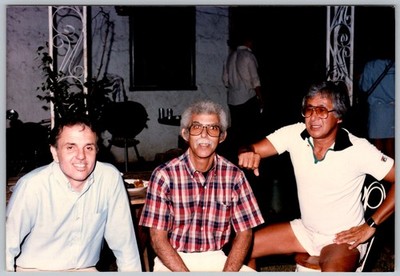
Vtg Color Snapshot Three Men Smiling Outdoors Plaid Shirt Polo Glasses 1990s

Vtg B&W Snapshot Soldiers In Field With Gear Military Men WW2 Era Camp 1940s

Vtg B&W Snapshot Family Farming Hay Wagon Oxen Pitchfork Rural Scene 1930s

Vtg B&W Snapshot Four Smiling Young Women Playful Shoulder Ride Field 1938

Vtg B&W Snapshot Man In Boat Scenic Coastal Village Harbor Red Lion 1950s

Vtg B&W Snapshot Pretty Woman In White Top & Skirt On Wooden Lawn Swing 1940s

Vtg B&W Snapshot Man Bill Cowly In Jeep Vehicle Palm Tree Tropical View 1940s

Vtg B&W Snapshot Diesel Locomotive Train Engine Passing On Rural Tracks 1950s

Vtg B&W Snapshot Group Friends Chorus Line Kick Pose Chester Springs Pa 1935

Vtg B&W Snapshot Five Young Women Teenage Girls Posing By Swimming Pool Water

Vtg B&W Snapshot Young Woman White Puffy Sleeve Formal Gown Flower Hair 1940s

Vtg B&W Snapshot Woman In Fur Collar Coat & Cloche Hat By Large House 1920s

Vtg B&W Snapshot Group Of Men Sailors In Uniforms On Ship Deck Military 1940s
Snapshots are amateur photographs — candid, casual, made by ordinary people with consumer cameras. The snapshot era opens with George Eastman's 1888 Kodak No. 1 (the first true consumer roll-film camera) and goes mass-market with the $1 Brownie in 1900. Sizes follow the film format and printing technology of the day, so dating a snapshot often comes down to its dimensions and paper.
HistoryOrigin & era
The first widespread amateur prints came from the 1888 Kodak No. 1 and exploded after the 1900 Brownie; the postcard-back era (1907–1930s) gave us the Real Photo Postcard (RPPC). Mid-century brought silver-gelatin prints with deckled (scalloped) edges; from the late 1950s the standard shifted to chromogenic color, finally settling on the 4 × 6 in print that still dominates today.
IdentificationHow to spot a Snapshot
- Silver-gelatin paper (most pre-1970 black-and-white) has a slight surface sheen.
- Deckled / scalloped edges are typical of c. 1940s–1960s prints.
- "AZO" or "VELOX" stamps on the back date the paper to specific decades.
- Postcard-back prints (POST CARD divided back) are 1907 onwards.
- Color prints with white borders are largely 1950s–1970s.
Snapshot sizes
Snapshot sizes track consumer film formats. Each entry below lists the print size and the era it dominates.
| Format | Inches | Millimeters | Notes |
|---|---|---|---|
| No. 1 / 2 Brownie contact print | 2¼ × 3¼ in | 57 × 83 mm | Early Kodak roll-film, c. 1900–1930s. |
| Real Photo Postcard (RPPC) | 3½ × 5½ in | 89 × 140 mm | Postcard-back era, 1907–1930s. |
| Postcard variant | 2½ × 4¼ in | 64 × 108 mm | Less common postcard-era trim. |
| 116 / 616 contact print | 2½ × 4¼ in | 64 × 108 mm | Folding-Kodak roll film, 1900s–1950s. |
| 620 contact print | 2¼ × 3¼ in | 57 × 83 mm | Box and folding cameras, 1930s–1950s. |
| Square (127 / 620 square) | 3½ × 3½ in | 89 × 89 mm | Mid-century box cameras, 1940s–1960s. |
| Standard small print | 3½ × 5 in | 89 × 127 mm | Silver-gelatin, c. 1940s–1970s. |
| Modern enlargement | 4 × 6 in | 102 × 152 mm | Color processing, 1970s onward (still standard). |
| Studio enlargement | 5 × 7 in | 127 × 178 mm | Common formal-portrait enlargement. |
| Large enlargement | 8 × 10 in | 203 × 254 mm | Studio portraits and event photos. |
Common questions
What counts as a vernacular snapshot?
A vernacular snapshot is an amateur photograph made by an ordinary person rather than a studio — candid, informal, often unposed. The format begins with Eastman's 1888 Kodak No. 1 (the first true amateur roll-film camera) and went mass-market with the $1 Brownie in 1900. The term covers everything from Real Photo Postcards to mid-century color prints.
What is a Real Photo Postcard (RPPC)?
A Real Photo Postcard is an actual silver-gelatin photograph printed on postcard-back paper, sized about 3½ × 5½ inches. Popular from 1907 into the 1930s, RPPCs are real photographic prints (not lithographs) and can often be dated within a few years by the stamp box on the back (AZO, VELOX, KRUXO, etc.).
How do I date a snapshot?
Border, edge, and paper give the strongest clues. Postcard-backs are 1907–1930s. Deckled (scalloped) white-bordered prints are roughly 1940s–1960s. Square prints (3½ × 3½ in) come from mid-century box cameras. Color prints with white borders are 1950s–1970s; borderless 4 × 6 in color prints are late 1970s onward.
Are old snapshots worth anything?
Most family snapshots have only sentimental value, but vernacular photography has a strong collector market. Snapshots with striking compositions, unusual subjects, early color (1940s–1950s Kodachrome), occupational scenes, or historical content (war, civil rights, Americana) can range from $5 to several hundred dollars individually, and large curated lots routinely fetch multiples of that.
Have Snapshots to sell?
We buy vernacular snapshot singly or by the lot. Send a few photos and we'll have an offer back in 24–48 hours.
Get an offer →